
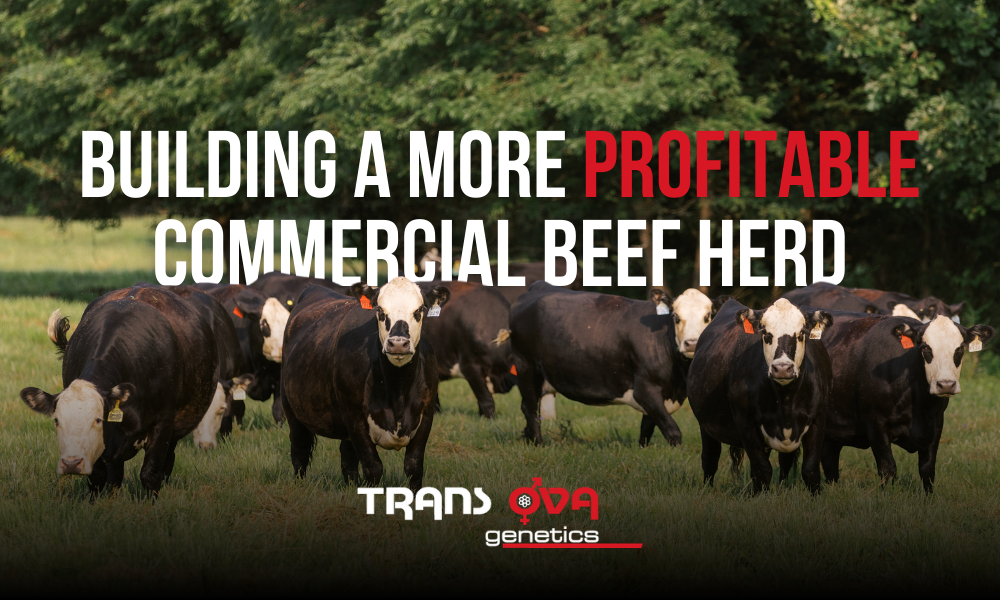
Commercial beef producers do not get paid for average.
They get paid for pounds, performance, fertility, and calves that hit the target — consistently.
Margins are tight. Input costs fluctuate. Labor is limited. Markets shift. Through all of it, genetics remain one of the most controllable drivers of long-term herd profitability.
At Trans Ova, we believe the question is not whether genetics matter, it’s whether your herd is ready for what’s next.
The Commercial Beef Challenge
In today’s environment, beef operations must balance:
- Calf performance and weaning weights
- Fertility and reproductive efficiency
- Longevity and structural soundness
- Feed efficiency and adaptability
- Market flexibility and revenue diversification
Traditional AI improves a herd over time. But for producers who want to move faster — whether to tighten uniformity, elevate carcass merit, or build stronger maternal lines — incremental change is often not enough.
That is where IVF and embryo strategies create real leverage.
When IVF Creates Value in Commercial Beef Herds
IVF is not just a reproductive technology; it’s a herd design strategy.
It allows you to multiply the influence of your most valuable females and accelerate genetic gain across your operation.
1. Accelerated Genetic Progress
Instead of producing one calf per year from a top cow, IVF allows multiple offspring annually from elite females.
That means:
- Increased selection intensity
- Shorter generation intervals
- Reduced genetic lag between herd average and elite sires
- Faster improvement in economically relevant traits
You are no longer building from the middle of the herd. You are building from the top.
2. Stronger, More Uniform Replacement Females
With conventional breeding, replacements often originate from a broad portion of the herd.
With IVF and embryo programs, replacement heifers can come from the top 5–10% of females — or from externally sourced elite donor genetics.
The result:
- Greater consistency in maternal traits
- Improved fertility and calving ease
- Stronger structural soundness
- More predictable cow longevity
- Uniform calf crops year after year
Uniformity in the cow herd translates to predictability in the calf crop — and predictability drives profit.
3. Strategic Herd Segmentation
Embryo strategies also allow commercial beef producers to segment intentionally:
- Elite females → Produce high-value replacements through IVF
- Middle-tier cows → Terminal matings to maximize pounds and carcass value
- Lower-tier cows → Managed for recipient selection or culled strategically
This approach allows you to simultaneously:
- Drive long-term genetic improvement
- Capture terminal performance premiums
- Improve overall herd efficiency
It is not about chasing one trait. It is about aligning genetics with your marketing endpoint.
4. Data-Driven Herd Design
IVF programs work best when paired with genomic testing and performance data.
Producers can intentionally select for:
- Weaning and yearling performance
- Maternal strength
- Calving ease and fertility
- Carcass merit and grid premiums
- Longevity and structural durability
This moves herd improvement from reactive to intentional.
You are not just breeding cows. You are engineering long-term performance.
The Economics: Investment with Compounding Return
IVF and embryo programs typically require a higher upfront investment than conventional AI. That is the reality.
But the return compounds over time through:
- Higher-quality, more productive replacement females
- Greater uniformity in calf crops
- Improved fertility and fewer open cows
- Increased feed efficiency, pounds, and carcass value
- Stronger lifetime productivity per cow
The ROI is not measured in one breeding season. It is realized across multiple calf crops and over the productive life of the cow.
For producers focused on sustainable profitability, that compounding effect matters.
When IVF Is a Strong Fit for Commercial Beef
These strategies make sense when:
- Accelerated genetic improvement is a clear goal
- Access to elite donors exists — or outside genetics are needed
- Replacement quality is a priority
- Long-term profitability outweighs lowest upfront cost
- Data and performance tracking guide decisions
- Meeting packer and feedyard demand for feed-efficient, heavy-muscled, high-marbling cattle is a priority
- The operation values sustainability, longevity, and forward-looking herd design
IVF is not about spending more. It is about extracting more value from your best females.
Tradeoffs to Acknowledge
Being producer-first means being honest.
IVF programs require:
- Planning and coordination
- Protocol discipline
- Labor and facility readiness
- Strong record-keeping and data accuracy
And the return is realized over time — not instantly.
But for commercial beef producers who want measurable progress, tighter uniformity, and a herd built for future market demands, that investment aligns with long-term goals.
The Bottom Line
If you simplify it, the strategy looks like this:
- Focus breeding on the best females in the herd
- Produce multiple calves per year from elite cows
- Fast-track genetic gain with intentional selection
- Customize traits that drive commercial profitability
- Build a herd designed for the next decade — not just the next sale
At Trans Ova, we work alongside commercial beef producers to design programs around real-world constraints and measurable outcomes.
Because being ready for what’s next is not about reacting to the market.
It is about building a herd that is positioned to lead it.
